Operate more without losing more.
One system for the whole practice: from the first call to the peso collected.
Scheduling, the visit, the clinical note, the codes and collections in one place — with artificial intelligence doing the work someone does by hand today.
Software hands you screens and the work stays with your team: somebody types, somebody looks up the code, somebody builds the report. Here the line runs end to end, and someone is accountable for the result.
For surgical subspecialists with an established private practice.
One flat fee, shown to you with your own measured month in hand · Never per patient and never a percentage of what we recover · We never touch your institution's software
How many payers bill through you today?
Your answer opens the form — 60 seconds, and we reply the same day.
Receivables · closed month
Illustrative view- Billed
- $ 128.4 M
- Collected
- $ 112.9 M
- Within terms
- $ 11.2 M
Past due, unpaid · $ 4.3 M
3 invoices to claim
The problem isn't in any one link. It's in the joints.
Why does this happen in practices that run well?
Every part works; nobody holds the whole
Your assistant books well, your biller files well, your accountant reconciles well. Each does her part and none sees the next one, so what gets lost isn't lost inside a task — it's lost in the handoff between them.
The trail ends at filing
When a payer disputes a claim, someone answers and files it. That's where the trail ends. Nobody verifies whether the answer turned into money, because at ninety days “it hasn't arrived yet” is normal — until it isn't.
The whole system lives in two heads and rotates every six months
The follow-up file, the order of the implants, which payer maps which code: none of it is written down. Every six months the team rotates and it leaves with them. You pay in parts; nobody is accountable for the whole.
You answered the payer's dispute. Did they ever pay you?
Almost nobody can answer it. Because the institution pays at ninety days, an invoice that never arrived looks exactly like one that's on its way — for three months. That's where the line starts paying for itself: every invoice with its expected date, its expected amount, and its actual status.
Dispute 4821 · answered
Response filed 92 days ago
Payment received: none
Recoverable ✓
Demo · illustrative view
What it costs you
is how the morning list gets onto the board. Nobody retypes twenty patients at seven a.m.
from start to your first measured month in front of you — or us telling you we found nothing.
you don't switch programs, we don't touch your institution's software, and your records stay exactly where they've always been.
Further reading (in Spanish)
One line, from the first call to the peso collected.
No patient falls between two links, and no peso either. We tell you precisely what runs today, what we do by hand, and what we're building with the founding practice.
- Running in a practice today
- We do it
- Being built
01
Arrives
One number, and nobody goes unanswered
Book a visit, repeat an order, schedule surgery, fix a rework — each one gets its own lane and an acknowledgement in minutes, not whenever someone can call back.
Being built02
Qualifies
First-timers arrive ready, or they don't take the slot
Before the appointment is given we know whether they have their images and whether the case is yours. Nobody travels in from another city twice over a missing X-ray.
Running in a practice today03
Books
It books on the calendar you already use
Your Google Calendar stays the calendar. The app shows the open slots by consult or surgery, books right there, and writes the outcome back. Nobody retranscribes, and your event titles are never touched.
Running in a practice today04
The day runs
The clinic, measured while it happens
Rooms, waiting times, who never came, who walked in, and the day's close on one screen. The morning list goes in as a photograph.
Running in a practice today05
Gets written
The medical record, in your own format
Drafted from what you already said in the consult, in the structure you defined. The record is yours, it stays where it always was, and you sign it.
Running in a practice today06
With its code
The code that actually gets paid, not just the diagnosis
ICD-10 says what they have; the procedure code is what gets billed — and every payer maps it differently and changes it over time. We suggest them and you can change them.
Running in a practice today07
Nobody drops
Every surgical order, tracked to the operating room
The ones you signed this month, which were operated, which weren't, and why. Without a colour-coded spreadsheet that breaks exactly when you start operating more.
Running in a practice today08
Gets paid
Generated, filed, paid — the three lists, cross-checked
What you did against what was filed against what reached the bank. Answered disputes tracked to payment, and the work that was done and never billed at all.
We do it
And the patient who was actually attended on time is the one who brings the next — which is why the line is a circle, and why the content and patient-acquisition side exists. It is the last stage, and only when you ask for it.
Seven fronts that today live in seven different files, or in somebody's memory. You aren't buying modules or seats: you're buying one accountable owner for the whole line.
Reception
- One number
- A lane per request type
- Acknowledgement in minutes
- Order repeats
Pre-consult
- First-timer filter
- Images before the visit
- Out-of-town patients
- Slots that don't burn
Scheduling
- On your own calendar
- Confirmation
- Rescheduling
- No transcription
The clinic day
- Rooms and waiting times
- Walk-ins
- No-shows
- Day close
- Monthly history
Medical records
- Your own format
- Drafted from the consult
- ICD-10 suggested
- You sign
- Selectable templates
Codes and scheduling
- Procedure codes per payer
- Current mappings
- Implants and room time
- Patient alerts
Patients
- Surgical order to operating room
- Post-consult follow-up
- Source of every consult
- Referrals
Billing and disputes
- Generated vs filed vs paid
- Receivables by age
- Disputes tracked to payment
- Never-billed services
- Expected value per UVR
AND AT THE OTHER END OF THE LINE
The clinic day, while it's happening.
Nobody has the statistics of their own clinic. How many were booked, how many never came, how many walked in, how long each one waited. Your assistant photographs the morning list and the day is measured — with nothing retyped.
NEXT
Julián Ospina
waiting 5 min · 1 more in the room
Move to cast room Y5Mariana Restrepo
08:30 · no payer
Record the consult01:52in consult
Camila Duarte
09:20 · no payer
Record the consult01:30in consult
No alerts today. 7 open follow-ups remain.
IN THE WAITING ROOM (2)
Billed
Within terms
Landed
Never landed
Pending action
Dispute deadline · 3 business days
Monthly report
It records itself while you see the patient.
No typing, no template, no coming back at night to finish the record. Start, see the patient, stop.
Carlos Andrés Rodríguez
RECORDING
01:41
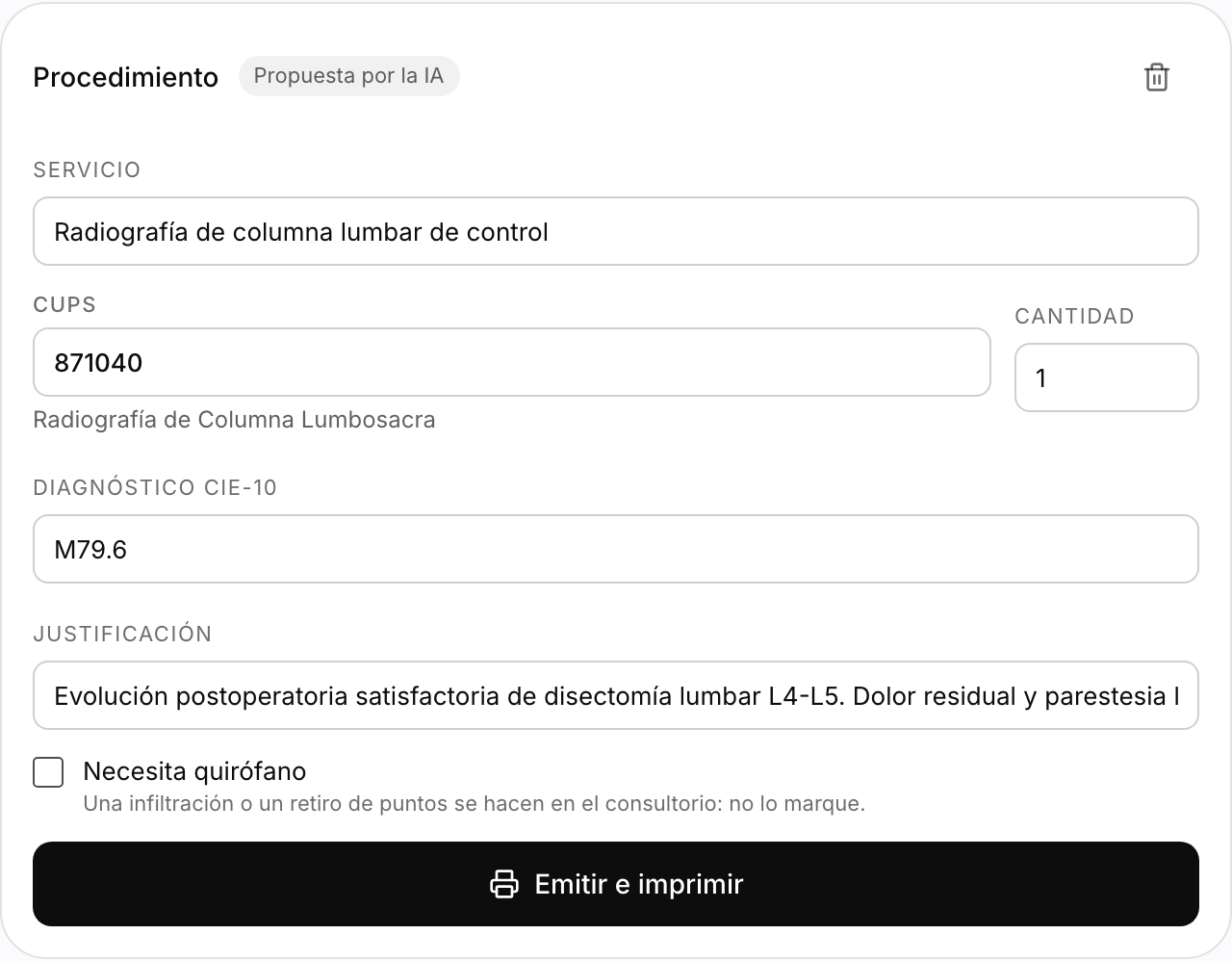
PauseStopIllustrative view The dictation comes out as a billable code.
The physician spoke for ninety seconds. The order came out with its CUPS code, its diagnosis and its justification — ready to issue, not to retype.
Real screen from the app · test data Your calendar answers questions.
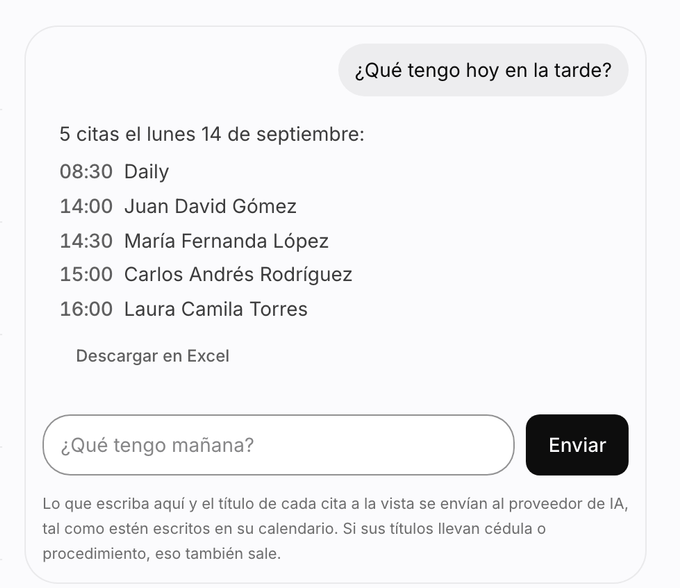
«What do I have this afternoon?» «What's free on Friday?» It reads your own Google Calendar and answers — and tells you, on the same screen, exactly what gets sent to the AI provider.
Real screen from the app · test data
Further reading (in Spanish)
Four questions about your practice. Today nobody can answer them.
They aren't rhetorical. At the end of the first month you have all four answers, with names and numbers.
How many calls to your practice go unanswered?
Nobody complains. They go to whoever picked up — and the authorization you already secured transfers with one line. You lose the patient who had already chosen you.
Of the surgical orders you signed this year, how many became surgery?
And of the ones that didn't, do you know why? No room, no implants, went elsewhere, or simply nobody called back. Today that answer lives in a colour-coded file only one person can read.
Of what you billed last month, how much reached the bank?
You generated twenty surgeries and were paid for eighteen. Nobody compares the two lists, because at ninety days “it hasn't arrived yet” is normal — until it isn't.
What are you doing every day and not charging for?
Daily rounds, consults for other services, immobilizations. They are billable procedures almost no surgeon charges, for years, without anyone noticing.
Start by knowing. Decide after.
- 01
A 20-minute conversation
About your practice, not about us: how many payers bill through you, who files for you today, what has become impossible to sustain. By the end you know whether this is useful to you, and we know whether we can carry it. Neither side commits to anything.
- 02
Your first month, measured
We put the line to work in your practice, and after thirty days you have your own month in front of you: how many patients, how many never came, how many orders you signed, how many became surgery, how much you billed and how much landed. You review it. If it isn't useful, you don't pay.
- 03
The price, with evidence
The monthly fee is presented afterwards, with your own numbers in front of you — not before: we'd rather you decide on evidence than on promises. One flat fee. Never per patient, and never a percentage of what we recover.
We guarantee what we control. Nothing else.
Pay on approval
We hand you your first measured month, you review it and decide. If it isn't useful, you don't pay. No conditions, no fine print.
The medical record is yours, and you sign it
We draft from what you already said in the consult; you correct it and you sign it. Custody of the record never leaves your hands, and it stays where you already keep it.
We suggest codes; we never assert them
Every ICD-10 and every procedure code is proposed to you and confirmed by you. We never treat a diagnosis as established, and we never file a code you haven't seen.
The receivables panel never sees a patient
It works with invoice number, payer, amount and dates. No names, no national IDs, no diagnoses: the money half can be audited in full without touching a single clinical field, and that is how we keep it.
On the clinical side we tell you exactly where it goes
To draft the record, the text is processed by AI providers under contract. We tell you which ones, how long they retain it, and how it's switched off. We do not build a database of your patients.
We never touch your institution's software
We work on your practice's side, with information that is already yours. No institutional permissions, no integrations you'd have to go negotiate.
We never guarantee how much we'll find, medical outcomes, or revenue. And we never charge a percentage of what you recover. Distrust anyone who promises you a figure before looking at your numbers.
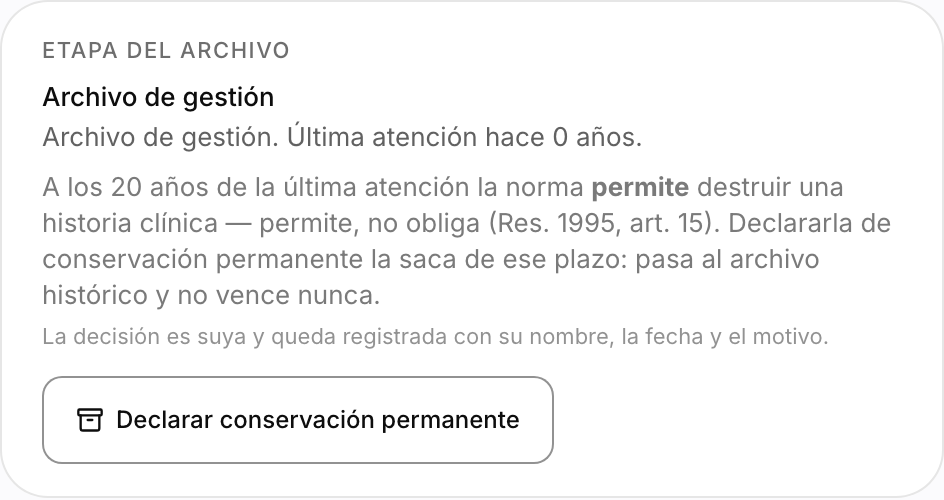
The law permits destroying it. It does not require it.
At 20 years, Res. 1995 art. 15 permits destroying a clinical record. The app tells you the difference and lets you declare permanent retention — with your name, the date and the reason.
Surgical subspecialties with an established private practice.
- 01Foot & ankle
- 02Shoulder & elbow
- 03Spine
- 04Knee
- 05Plastic surgery
We work with two practices at a time, because our people are inside the operation of each one. If your practice isn't at this stage yet, we'll tell you so directly.
Built so you can audit it.
Why did we build Be HumAIn this way?
The best surgeons we know operate all day and have no way to know whether they were paid. Not because their team fails — their assistant and their accountant do their part well — but because nobody has the whole picture in front of them. We built Be HumAIn to close that gap without asking for hours you don't have.
That's why everything we do leaves a trail: every patient with their arrival time, every order with its outcome, every invoice with its expected date, every month closed in the same format. If a peso didn't land, you're the first to see it — not the last.
The last stage — and only if you ask for it
And when you want it, the right patients.
It isn't part of what's above and isn't billed with it. The line closes on its own — the patient who was actually attended on time is the one who brings the next. This is for when you want to open the door to the ones who can't reach you today.
The objection
“My audience knows my face. An avatar there costs me the trust it took years to build.”
You're right, and that's why we don't propose it there. Your usual account stays you, filmed by you. El Estudio is for the market your time can't reach: another account, another language, another country — where you don't yet have trust to spend, and do have a schedule that can't absorb the travel.
Your face and your voice, with signed consent
Never a generic presenter and never another person's likeness. Without written consent, nothing gets generated.
Your words, approved before they exist
The script is yours and you sign it. We don't add, we don't soften, and we don't invent a clinical claim.
Every video approved before it posts
Nothing goes out that you haven't seen. And all AI-generated content is disclosed as such, on every platform.
Every consult traceable to the video that brought it
The same standard as the rest of the line: if it can't be attributed, you can't know whether it worked.
We promise no results here, and we won't show you another doctor's numbers to convince you. This stage opens when you ask for it, and not before.
Ask us about El Estudio →QUESTIONS WE GET
What surgeons ask before saying yes.
A 20-minute conversation to start, then one session with your assistant and your biller to understand how they work today. After that you approve exceptions. You don't switch systems, migrate anything, or hire anyone.
In how much of the work the system does. Here the line runs end to end — the day board, scheduling on your own Google Calendar, the clinical note and the codes — and where a hand is still needed, reconciliation and dispute replies, someone is accountable for the result. And we don't ask you to migrate anything: we work with what you already have.
They write the note, and some write it very well. The note is not where the money is lost. ICD-10 says what the patient has; the procedure code is what gets billed, is mapped differently by every payer and changes over time — and from there it still has to be scheduled, billed, filed and actually paid. We cover that part, which is where the money is.
No. We start with your operation and your money: the consult, the medical record, the codes, surgical scheduling, receivables and disputes. The content and patient side exists and we deliver it in full, but it's the last stage and only when you ask for it.
Receivables-recovery firms work with clinics and multi-doctor groups, because their model needs that volume; they typically won't take an individual practice. And they only look at the last link. We're built for the individual surgeon and we cover the whole line — which is also why we can charge a flat fee instead of a percentage of what you recover.
Hiring adds a person; it doesn't add someone accountable for the whole. Today your assistant, your biller and your fellows already handle parts of the process, and still nobody can tell you how many of your orders became surgery or how much of what you billed landed. We answer for the complete result — and when your team rotates, the process stays.
Two different answers, because these are two different things. The receivables panel works only with invoice number, payer, amount and dates — not one name goes in. On the clinical side we do handle identified data in order to draft your record: that record is yours, you sign it, and it stays where you already keep it; the draft is processed by AI providers under contract, and we tell you which ones and how long they retain it. All of it under Colombian data-protection law, with an explicit treatment policy.
We tell you exactly that, with your numbers in front of you — and you don't pay. Knowing your operation is healthy is information you don't have today either. And in most practices the leak isn't only money: it's the hours your team loses filing, hunting for codes, and holding up a WhatsApp line. We're still useful there.
One system for the whole practice: from the first call to the peso collected.
Let's talk for 20 minutes →LET'S TALK ABOUT YOUR PRACTICE
Twenty minutes about your practice.
Not a demo. We ask how your operation runs today and tell you straight whether we can carry it. Requesting it grants access to nothing. 60 seconds. We reply the same day.